
A classic scenario in software engineering: The development team proudly releases a brand-new, blazing-fast web application built with React. The user interface is buttery smooth, and navigating between pages feels instantaneous (thanks to Single Page Application architecture). But a few weeks later, the Marketing team is panicking—Google isn't indexing the articles, and organic traffic is flatlining at zero. When inspecting the source code (Ctrl + U), the only thing Googlebot sees is an empty div: <div id="root"></div>.
To rescue this "disaster," developers often whisper a revolutionary solution to each other: Migrate to Next.js.
But does using Next.js actually guarantee good SEO? Why has it earned the title of the "gold standard" framework for curing React's SEO ailments? Let's decode the architecture beneath the surface.
1. Why is Pure React (SPA) the "Enemy" of SEO?
To understand why Next.js was created, we must diagnose the fundamental flaw of Single Page Applications (SPAs) written in raw React (or Vue/Angular).
By default, these frameworks utilize Client-Side Rendering (CSR). This means the server only returns a blank HTML skeleton and a massive bundle of JavaScript files. The user's browser (the client) must download the JS, execute it, and only then calculate and "paint" the visible content on the screen.
The Problem with Googlebot: When Google's crawler (or social bots from Facebook/Twitter when scraping a link) visits your web page, it initially sees a blank screen. While Google has gotten smarter and can execute JavaScript to read content, this "two-wave indexing" process is extremely resource-intensive and time-consuming. In many cases, the bot gives up before the JS finishes loading, resulting in the page remaining unindexed (Not Indexed).
2. How Does Next.js Rescue SEO?
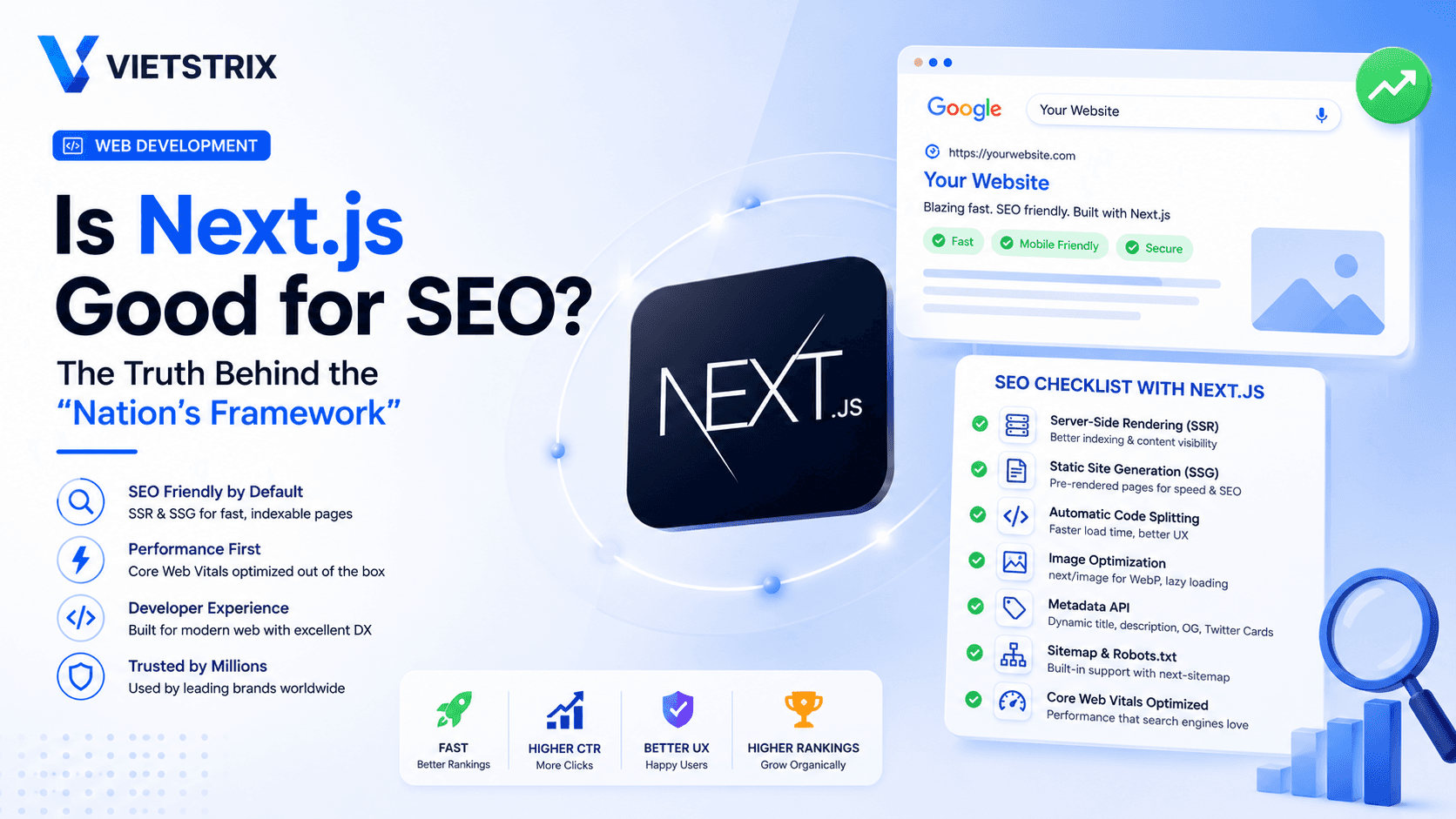
Building a website with Next.js is EXCEPTIONALLY GOOD for SEO because it was designed specifically to overcome React's fatal weakness through advanced rendering mechanisms:
Server-Side Rendering (SSR): Instead of forcing the user's browser to render the UI, Next.js pushes that heavy lifting to the Server. The server fetches the data, generates a complete HTML file packed with all the content, and sends it to the browser. Now, when Googlebot hits the page, it instantly "reads" the articles, images, and meta tags without executing a single line of JavaScript.
Static Site Generation (SSG): Even more powerful than SSR for static content. Next.js can pre-build entire pages into static HTML files during the build process (deployment). The page load speed becomes nearly instantaneous (zero latency), easily achieving perfect Core Web Vitals scores.
3. 4 Reasons Next.js is the "Gold Standard" for Technical SEO
Next.js doesn't just solve the content visibility problem for bots; it provides a comprehensive, built-in toolkit for optimizing Technical SEO:
Optimizing Page Speed (Core Web Vitals)
Speed is a direct ranking factor for Google. Next.js automatically implements Code Splitting, loading only the necessary JS for the current page. Combined with SSG, achieving a "green" LCP (Largest Contentful Paint) score (< 2.5s) becomes effortless.
Next-Gen Image Optimization (Next/Image)
The <Image /> component in Next.js is a masterpiece. It automatically converts images to modern formats like WebP/AVIF (which are significantly lighter than JPEG/PNG), resizes them based on the user's device screen, and enables lazy-loading by default. This completely eradicates CLS (Cumulative Layout Shift) errors caused by jumping layouts.
Effortless Metadata Management (App Router)
With Next.js 13+ (App Router), declaring SEO tags (Title, Description, Canonical tags, Open Graph for social sharing) is easier than ever via the Metadata API. It seamlessly supports both static and dynamic metadata generation for individual pages.
Server Components (The Future Architecture)
This groundbreaking architecture allows components to execute entirely on the server, sending pure HTML to the client without the accompanying JavaScript baggage. Reducing the JS bundle size translates directly to faster, smoother page loads, especially on weaker mobile devices.
4. The Harsh Truth: Will Next.js Automatically Guarantee Top Rankings?
From a Software Engineer's perspective: NO!
You need to clearly understand this boundary: Next.js only solves the Technical SEO problem. It builds a massive, perfectly paved highway with no potholes, allowing Googlebot (the car) to cruise through and collect information as smoothly and quickly as possible.
But to rank #1 on Google, you still need high-quality Content and strong Authority (Backlinks). If your Next.js infrastructure is flawless but your articles are plagiarized or offer no value to the reader, Googlebot will still rank your website poorly.
The Winning Formula:
Next.js (Excellent Technical SEO) + Content E-E-A-T + Quality Backlinks = #1 on Google.
5. Conclusion: When Should You Use Next.js?
If you are only building an internal Admin Dashboard that doesn't need to be discovered by search engines, pure React (SPA) is sufficient.
However, if you are building an E-commerce site, Blog, News portal, or Corporate Landing Page—where every drop of organic traffic from Google equals revenue—then Next.js is practically a MANDATORY choice in the current landscape.
If your enterprise currently owns a React Web App struggling to climb Google's rankings, or if you need to develop a new platform with SEO-standard architecture right from the starting line, Vietstrix is the team you are looking for.
With deep expertise in the React/Next.js ecosystem and technical SEO infrastructure, we are committed to delivering a product that not only boasts an outstanding UI but is also absolutely friendly to all search engines. Contact Vietstrix right here to get a comprehensive website audit and consulting on the most optimal solutions!
About the Author:
This article was synthesized and compiled by the Software Engineering Team at Vietstrix—combat-tested experts in designing Frontend architectures, migrating SPAs to SSR/SSG, and optimizing Core Web Vitals for large-scale projects.
